
Customer Background
Centralized long-term apartments, talent residences, affordable-rental housing and campus dorms share a common operations headache: many properties, scattered devices and fast tenant turnover. Operators must solve how to bind rooms to locks accurately, how tenants get valid PINs within a period, how device status reports back, how remote meter reading and power control execute, and how lock faults are serviced.
DejaOS does not add another standalone device console. It builds an IoT middleware that connects the business platform with on-site gateways and BLE sub-devices: the platform issues PIN, device and meter commands, the middleware turns them into gateway MQTT commands pushed to room devices, and returns results, alarms and access logs.
Pain Points
Messy device binding. Store-building-unit-floor-room hierarchies make manual device entry error-prone and costly to trace later.
Complex PIN management. Move-in issue, move-out revoke, and temporary rights for viewing/cleaning/repair are easy to miss manually, leaving stale rights and security gaps.
Offline-lock complaints. When a lock goes offline the business side cannot confirm execution, and blame is hard to assign when a tenant is locked out.
Manual energy settlement. Meters are read by hand; move-out settlement, arrears control and consumption analysis lag, disconnecting finance from operations.
Heavy multi-version maintenance. Gateway firmware, BLE chips and sub-device versions are mixed, with no unified upgrade or version view, raising field cost.
DejaOS Solution
Property hierarchy台账. A store-building-unit-floor-room hierarchy synced from the business platform binds every device to a clear space, cutting mis-binding at the source.
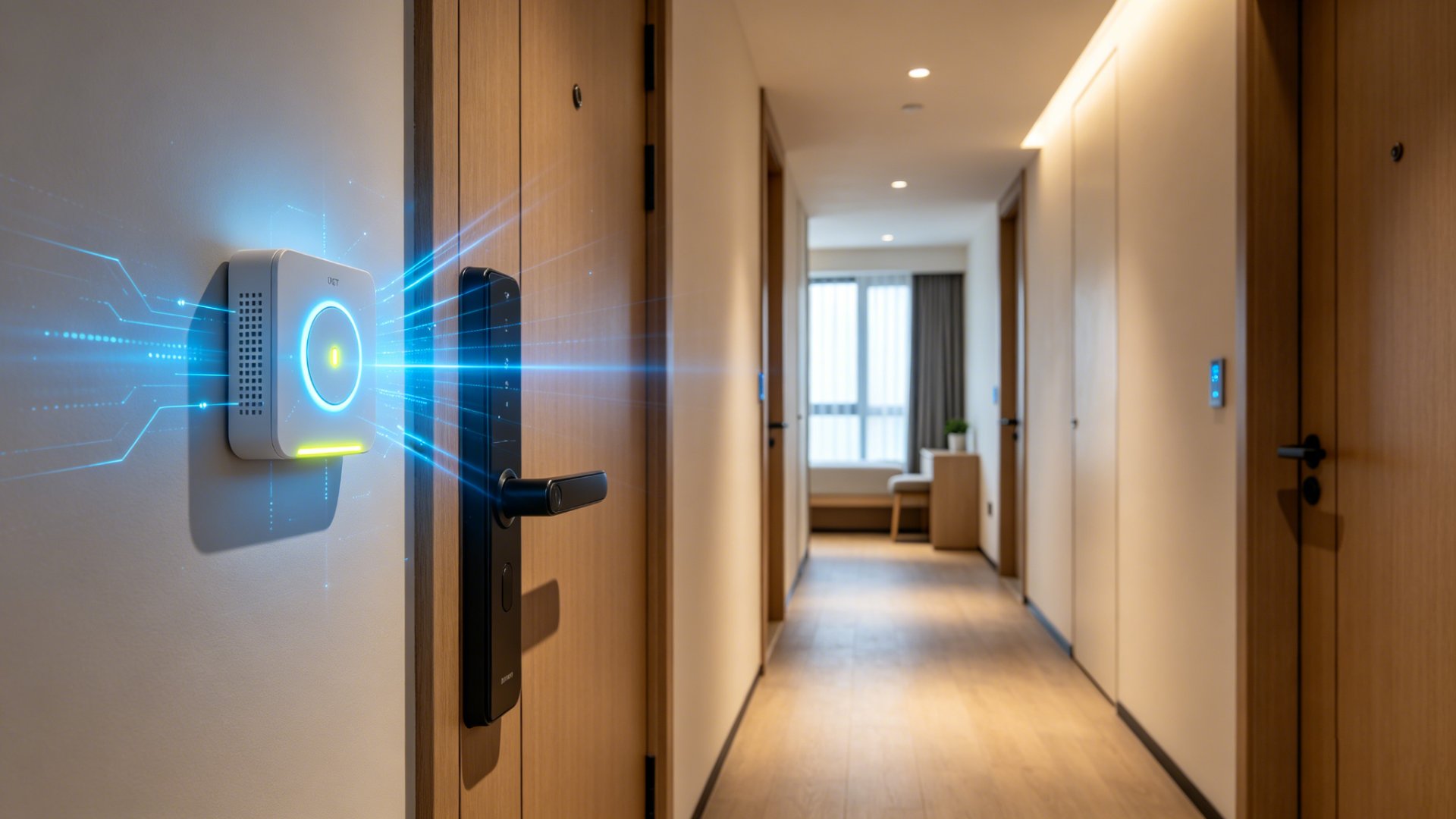
Gateway access. BG101/BG102 BLE gateways handle MQTT access, online status, reboot, reset, key sync, version query and OTA, bringing room BLE devices to the cloud.
Locks & BLE sub-devices. Discover nearby devices, connect/sub/add/remove, query status and version, managing IL60, L200 and other smart locks remotely.
PIN lifecycle. Add/modify/freeze/unfreeze/delete and list PINs, plus short/long-term offline PINs, tightly bound to the lease lifecycle.
Platform integration. Standard APIs cover property query, device CRUD, event reporting and operation callbacks, letting lease/move-in/move-out/billing systems control field devices directly.
Energy. Remote meter reading, history attributes, power cut/restore, extensible to billing, arrears control, move-out settlement and energy savings.
Events & O&M. Log door, low-battery, tamper, repeated PIN errors and online/offline events; every PIN push, device command, OTA and retry has an operation log to locate "platform issued but device not executed".
O&M mini-program. Field staff log in, view properties, add gateways/locks, bind, print/QC/reset records, fit for new-store launch and whole-building batch delivery.
Expected Business Value
Lower delivery & O&M cost. Hierarchical binding + bulk import + mini-program QC make new-store launch, retrofit and whole-building batch install controllable, reducing key-handover and cylinder-replace cost.
Contained access risk. PINs bound to lease lifecycle auto-issue on move-in and auto-expire on move-out, avoiding leftover rights and proxy access, fully traceable.
Energy & finance automation. Remote metering and power control feed billing, move-out settlement, arrears alerts and consumption analysis, unifying finance and operations.
Scalable replication. Reusable for staff dorms, campus dorms, hotel apartments, co-working and park dorms — one middleware serving multiple brands and stores under a "room + lock + energy" model.