
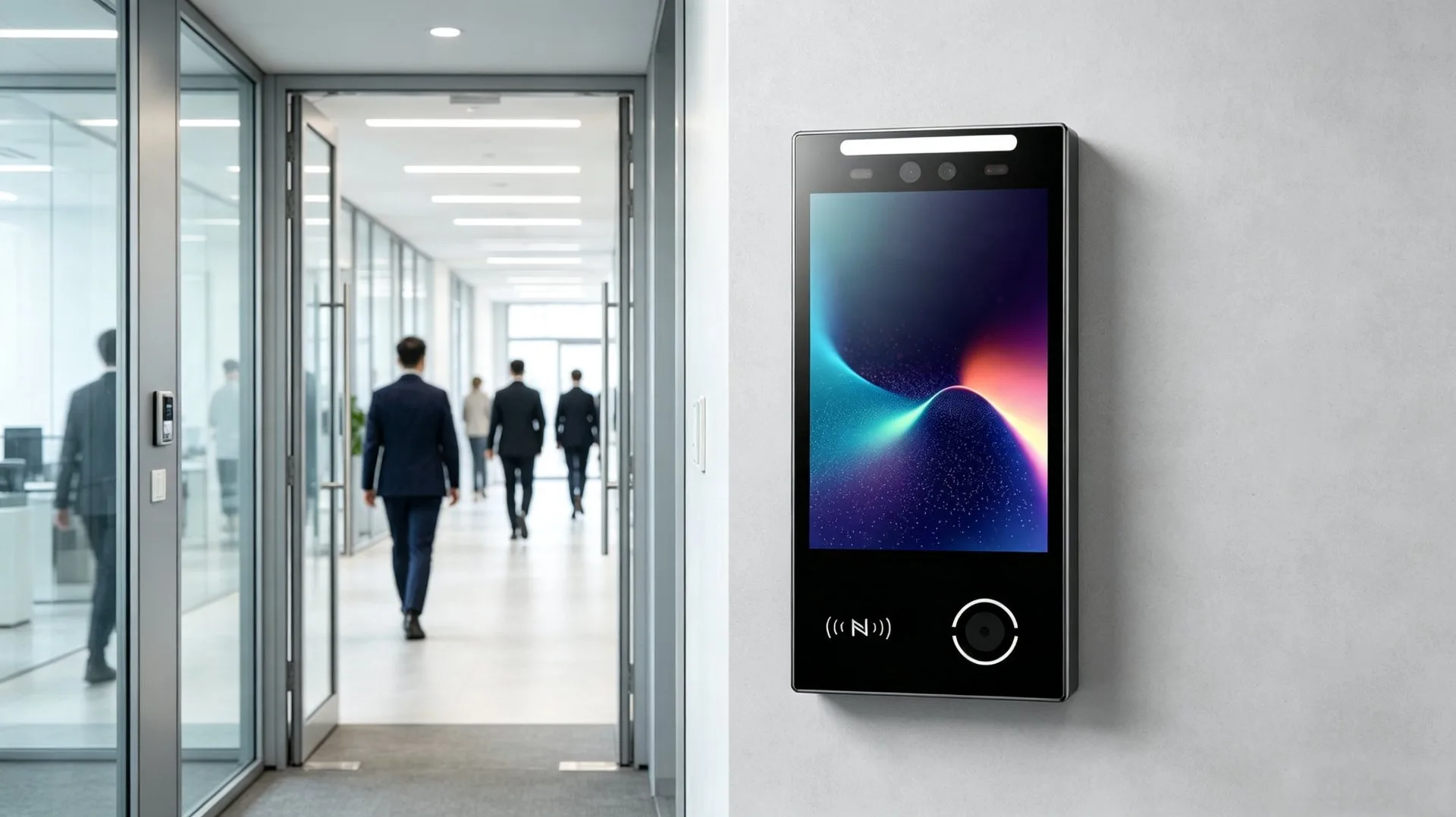
Face recognition access control uses the face as the credential: as a person approaches the terminal, it captures the face, matches against the enrolled gallery, and opens on a pass — no card, phone or stop required.
How recognition works
The terminal camera captures a face image, a local algorithm extracts a feature vector, then performs 1:N matching (one-to-many) against the authorized gallery and returns the identity above threshold. The whole pipeline runs on-device for low latency and stable passage.
Liveness detection is the security base
To resist photo, video or mask attacks, the terminal needs liveness detection to confirm a real living person rather than a spoof. Common approaches include dual-infrared, 3D structured light and motion prompts, so "real person + authorized" both hold before opening.
Frictionless passage
Versus card or QR, the biggest value of face access is frictionless passage: no active credential presentation, no queueing at peaks. This matters most at metro turnstiles, campus entrances and office lobbies with high concurrency.
Data compliance boundary
The face is biometric sensitive data. Compliant projects need data localization, authorized retention, minimal collection, and support for private deployment with tiered permission audit — hard mandates for government and city-scale projects.
Selection tips
Start from the main user group and peak: high concurrency calls for strong on-device compute; compliance level decides private/hybrid deployment; finally confirm integration openness with HR, one-card and visitor systems. Score the five for priorities.
CoolCode酷豆 practice reference
CoolCode酷豆 face terminals run at metro turnstiles across 25 cities, with on-device 1:N matching under 300ms, exported to 100+ countries and regions, with 55 machine-vision patents. These serve as baselines for "high concurrency + in-house algorithm" capability.